We recently had an interesting email contact with a lady with celiac disease about whether chufas would be suitable for people with celiac disease. First a recap:
wheat allergy is getting an allergic reaction to wheat, other grains can be eaten though
glutensitivity you can have if you are tested for wheat allergy or celiac disease, it is not detectable but you still suffer from gluten
celiac disease (or gluten intolerance), being unable to tolerate gluten at all
The latter was fodder for something I didn't know. I thought, chufas are gluten-free and therefore suitable for people with celiac disease. Through the lady of mail contact, I found out that there is a limit up to when a product can be called gluten-free. That limit is 20 ppm, or 20 milligrams per kilo. This 20 milligrams is a safe standard for most celiacs, but can still cause problems for a few who are extremely sensitive.
Every step in the production process can pose a risk ...
So her question was, how are the chufas harvested, transported, packaged and shipped? Easy to find out, however, it is not, and ultimately it does not guarantee that the chufa 100% is gluten-free.
Because from a given, a gluten-free product the chufa, you come to process, namely a controlled certification system. Our supplier is certified gluten-free, we ourselves are not as this costs a lot of money but we do work gluten-free.
However, if a certificate does not comply (because of the 20 ppm limit which is still too high for extremely sensitive celiacs), you actually come down to randomness, chance and luck. Luck if the driver of the tractor or employee in Spain does not eat a wheat sandwich or the farmer in Africa (Niger) happens not to have some wheat at home. Even though we gain insight into this randomness and chance, it suggests security which is probably not there.
A 100% waterproof system
I pointed her to the one system which does make 100% foolproof - the body! Whether it was an option to eat one chufa. She ended up eating a handful of chufa with fortunately a good outcome. No trouble at first. To be sure, she had to test more often and for longer.
Again, for most people with coeuliakia, 'gluten-free' is enough!
The place to learn the story of chufa is Valencia in Spain. In Alboraya, a small village just above Valencia, the weather, sandy soil and availability of water make the area ideal for growing chufas. The drink traditionally made from chufa is Horchata and has been drunk in Valencia for hundreds of years.
Oranges
We went to Valencia for the first time last year and liked it so much that we went again this year. The map shows all the places.
Flight and accommodation
Last year we left with Transavia from Rotterdam / The Hague Airport, this year with Transavia from Eindhoven Airport. We spent €294 on 2 tickets, fixed seats and one suitcase. One mistake we found out late, the return trip did not have a connection to a train back to the Hague area. Something to bear in mind, we were now losing €60 extra on a parking space for a week. Going late at night after the return trip was not our preference either.
Valencia railway station
Via booking.com, we booked a flat in the Russafa district (1. on the map), just below the centre of Valencia. Close to the station, the metro and you can walk straight into the old town. The neighbourhood is quiet and has plenty to offer itself. We paid around €600 for 7 nights for 2 people.
Horchata
We came to town for horchata. There are lots of places to drink horchata (horchateria), but one is not the other.
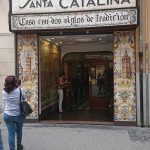
El Siglo and Santa Catalina (2.)
The two oldest horchaterias are in the centre. One, El Siglo from 1836 was undergoing renovation; fortunately, a beautiful tile image was still visible.
The other, Santa Catalina which has supposedly been around for 2 centuries was open and there we drank horchata and ate chufa ice cream and fartons. Fartons are actually empty, airy buns that are not very tasty by themselves but are mainly meant to be dipped in your horchata.
The horchata here is very sweet! A tip though is to look for chufa oil here, 250 ml is €9.90 here.
Xé Valencia (3.)
Another horchateria is Xé Valencia, with a more modern feel. What attracted us here was 'La horchata de chufa sin azúcar' or horchata without sugar. Unfortunately, it was not there when we asked for it, and when we asked further, it turned out that it did not contain sugar but stevia and fructose.
Daniel (4.)
A better horchateria that does sell real horchata without sugar is Daniel in Colon's market hall. There is also a nice Japanese restaurant down here that we want to go to next year. You can also go to the toilet downstairs. Casa de L'Orxata is another horchateria we haven't been to, this brand also sells its horchata in ready-made packs that do, however, contain a dose of e-numbers.
Market hall Colon
Horchateria Daniel
Casa de L'Orxata
We discovered Daniel the last morning. Next year, we will ask if the horchata can also be taken home.
Chufa's Daniel
Horchata Daniel
Daniel with painter Salvador Dali
Punt de Sabor (5.)
Punt de Sabor horchata
A Horchata which we liked (not too sweet) was the one at Punt de Sabor. It is an organic shop that we love to visit. You can buy lots of vegetables and fresh juices here. The horchata here is sweetened with a little cane sugar.
Mercado Central (6.)
Chufa's Mercado Central
The big market hall in the middle of the city. A magnificent building where you can buy a lot of meat and fresh fish in addition to horchata, along with vegetables, nuts and southern fruits. If you want to make your own horchata in your stay, you can also easily buy loose chufas here.
At a horchateria in the market hall whose name I forgot to write down, there is a nice video about chufas and making horchata.
Món Orxata (7.)
A major supplier of chufas comes from Alboraya and is called Món Orxata. It is the company behind the ChufaMix. They have several carts scattered around the city where you can buy fresh horchata, like you get an ice cream with us. Some of the carts sell organic horchata, sweet nonetheless. Món Orxata also has its own shop near the railway station (for the high-speed line). You can buy many of their products here and also drink fresh horchata.
Chufa
Near the station
Horchata trolley
Other chufa discoveries
In the Benimaclet district, we went to an ecological market and tapas route. The latter fell a bit short because apparently that part lasted until 2pm instead of the 6pm as stated on the poster. We were also just in time for the market but what a find, a company 'Xufacity' called had a whole stall full of homemade chufa products. We got a lot of inspiration from it.
Sesame seeds coated with chufa flour and sugar
Muesli with chufa and oatmeal
Chocolate paste made from chufa extract and chocolate
Soaked unpeeled chufa coated with sugar and cinnamon
Other places to visit
Almalibre Acai Bar (8.)
We found a great use of horchata at Almalibre Acai Bar. Here they combine horchata with acai with the appropriately named 'Valencian Amazon', a successful combination as far as we are concerned. You can also choose chufas as topping on the acai bowl. A nice place which seemed to be mostly frequented by tourists.
Chufas as topping
Valencian Amazon
Almalibre Acai Bar
Acai bowl with chufas
Malmö (9.)
Malmö
We wanted to go to the oft-described organic restaurant Copenhagen but it was closed, however, Molmö falls under the same group. The food looked top notch, but our hunger was not really satisfied because of the many carbs and vegetables. We ourselves do not eat soy products or many nuts which in itself makes it a fine organic vegan restaurant.
Bodegá de la Sarieta (10.)
Bodego de la Sarieta
Looking for Valencia's tastiest paella, we came across Bodegá de la Sarieta via reviews. A cosy place that takes a while to find, with friendly staff. The paella takes half an hour so if you're hungry you'd better order an appetiser first.
The paella was delicious, we were given one pan to eat from together. Whether it is the tastiest paella in Valencia remains to be seen, next year we will visit another establishment.
Kimpiri (11.)
Another vegan restaurant where they serve high quality food is Kimpiri. They have a Japanese slant and is one of the few places that also focuses on tea, we drank Kukicha with our food.
Mel I Salut (12.)
Mel I Salut
Mel I Salut honey
Honey is much cheaper in Spain than in the Netherlands as are propolis and bee pollen. A great shop to buy honey is Mel I Salut. They have a rich collection of honey, from pitch black to almost white. Also a Limoncello with only sugars from the fruit, also in orange version.
Bluebell coffee (13.)
I have a weakness for coffee shops! With nice coffee that is, these are not easy to find in Valencia. One exception is 'Bluebell Coffee' which also happened to be close to our flat. They are people with a passion for coffee and the atmosphere is wonderfully calm.
Bluebell coffee Valencia
Bluebell coffee terrace
Cappuccino & matcha tea
Organic supermarkets
If, like us, you like to eat organic, there is plenty of choice in Valencia! There are several organic supermarkets not too far from each other.
Navarro Herbolario (14.)
Our favourite is in the west of the city centre. This shop is very complete with a wide range of products, its own butcher, a large tea department and, last but not least, a catering section. This is where we came several times, especially in the last few days. Among other things, they have a vegan daily menu or an organic burger with goat cheese. The collection of cakes is also impressive, we counted about 23 at one point.
Ecorganic (15.)
Another fine organic supermarket is Ecorganic. Lots of scoop bins (handy if you only need a little rice, coconut sugar, beans or herbal tea), nice staff, freshly ground mince and a bit cheaper than Navarro Herbolario. Our favourite were Aioli, sweet crisps and we bought a handy nut milk bag there.
Ecorganic Valencia
Aioli, jar a day
Nut milk bag
La Higuera (16.)
A somewhat upmarket natural shop with only some ham in terms of fresh produce but miso soup in packets (with no additives) and the only place that sells chufa flour.
Supersano (17.)
A nice organic supermarket.
Transport in Valencia
Metro
If you travel a lot on the metro, buying a 10-ride pass is recommended. Buying from one of the vending machines is easy to do (English language available), only determining which zones are sufficient is a puzzle. Zone A is sufficient for the city centre and the beach. You pay €1 for the ticket itself, you can keep it so you can recharge it next time if necessary.
Walking
Walking is recommended in the compact centre, everything is close together and that way you get to see something.
Cycling
This year we discovered Valenbisi, Valencia's bike rental system. It is a pleasant system which works well. Throughout Valencia, there are stands with a row of bikes and a pole where you can rent a bike. At most poles you can also buy a card. You can choose the English language so it works well. You buy a card for a week for €13, which is printed out on the spot and has a number on it. With this number and a personal pin code, you can rent a bike at all the parkings. The first half hour is free, after that there are small charges. If you get the hang of it, you can ride from shelter to shelter so you never have to pay anything extra. In an empty lock, you put your bike down after which two beeps confirm that the bike has been properly put back.
On the accompanying app, you can see exactly where you are and where the nearest parking is. Mind you, you pay by credit card and there is a €150 deposit that you get back later. The only drawbacks of the system: there are parkings that are more popular than others. That means you sometimes want to rent a bike in places where there are no more bikes. At other places, you want to put your bike back but every lock is already taken. Then it's on to the next place, which fortunately isn't very far.
Bus
Even after 2 visits, we still have absolutely no idea how to determine which bus to take where. Perhaps next year.
Beach
Valencia's beach is very beautiful! A graceful promenade and very wide beach. You can park your bike near the beach, the nearest metro is a bit of a walk though. The water was still freezing cold in mid-April! Along the promenade, a cycle path leads directly to Alboraya, bringing us full circle.
NL
NL
EN
FR
DE
NL
NL
EN
FR
DE
Manage cookie consent
ChufaFactory uses cookies to optimise the website.
Functional
Always active
The technical storage or access is strictly necessary for the legitimate purpose of enabling the use of a specific service explicitly requested by the subscriber or user, or for the sole purpose of carrying out the transmission of a communication over an electronic communications network.
Preferences
The technical storage or access is necessary for the legitimate purpose of storing preferences that are not requested by the subscriber or user.
Statistics
The technical storage or access that is used exclusively for statistical purposes.The technical storage or access that is used exclusively for anonymous statistical purposes. Without a subpoena, voluntary compliance on the part of your Internet Service Provider, or additional records from a third party, information stored or retrieved for this purpose alone cannot usually be used to identify you.
Marketing
The technical storage or access is required to create user profiles to send advertising, or to track the user on a website or across several websites for similar marketing purposes.




 NL
NL  EN
EN  FR
FR  DE
DE