The place to learn the story of chufa is Valencia in Spain. In Alboraya, a small village just above Valencia, the weather, sandy soil and availability of water make the area ideal for growing chufas. The drink traditionally made from chufa is Horchata and has been drunk in Valencia for hundreds of years.
Oranges
We went to Valencia for the first time last year and liked it so much that we went again this year. The map shows all the places.
Flight and accommodation
Last year we left with Transavia from Rotterdam / The Hague Airport, this year with Transavia from Eindhoven Airport. We spent €294 on 2 tickets, fixed seats and one suitcase. One mistake we found out late, the return trip did not have a connection to a train back to the Hague area. Something to bear in mind, we were now losing €60 extra on a parking space for a week. Going late at night after the return trip was not our preference either.
Valencia railway station
Via booking.com, we booked a flat in the Russafa district (1. on the map), just below the centre of Valencia. Close to the station, the metro and you can walk straight into the old town. The neighbourhood is quiet and has plenty to offer itself. We paid around €600 for 7 nights for 2 people.
Horchata
We came to town for horchata. There are lots of places to drink horchata (horchateria), but one is not the other.
El Siglo and Santa Catalina (2.)
The two oldest horchaterias are in the centre. One, El Siglo from 1836 was undergoing renovation; fortunately, a beautiful tile image was still visible.
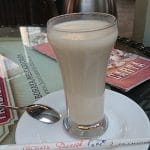
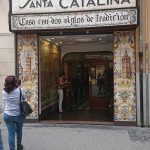
The other, Santa Catalina which has supposedly been around for 2 centuries was open and there we drank horchata and ate chufa ice cream and fartons. Fartons are actually empty, airy buns that are not very tasty by themselves but are mainly meant to be dipped in your horchata.
The horchata here is very sweet! A tip though is to look for chufa oil here, 250 ml is €9.90 here.
Xé Valencia (3.)
Another horchateria is Xé Valencia, with a more modern feel. What attracted us here was 'La horchata de chufa sin azúcar' or horchata without sugar. Unfortunately, it was not there when we asked for it, and when we asked further, it turned out that it did not contain sugar but stevia and fructose.
Daniel (4.)
A better horchateria that does sell real horchata without sugar is Daniel in Colon's market hall. There is also a nice Japanese restaurant down here that we want to go to next year. You can also go to the toilet downstairs. Casa de L'Orxata is another horchateria we haven't been to, this brand also sells its horchata in ready-made packs that do, however, contain a dose of e-numbers.
Market hall Colon
Horchateria Daniel
Casa de L'Orxata
We discovered Daniel the last morning. Next year, we will ask if the horchata can also be taken home.
Chufa's Daniel
Horchata Daniel
Daniel with painter Salvador Dali
Punt de Sabor (5.)
Punt de Sabor horchata
A Horchata which we liked (not too sweet) was the one at Punt de Sabor. It is an organic shop that we love to visit. You can buy lots of vegetables and fresh juices here. The horchata here is sweetened with a little cane sugar.
Mercado Central (6.)
Chufa's Mercado Central
The big market hall in the middle of the city. A magnificent building where you can buy a lot of meat and fresh fish in addition to horchata, along with vegetables, nuts and southern fruits. If you want to make your own horchata in your stay, you can also easily buy loose chufas here.
At a horchateria in the market hall whose name I forgot to write down, there is a nice video about chufas and making horchata.
Món Orxata (7.)
A major supplier of chufas comes from Alboraya and is called Món Orxata. It is the company behind the ChufaMix. They have several carts scattered around the city where you can buy fresh horchata, like you get an ice cream with us. Some of the carts sell organic horchata, sweet nonetheless. Món Orxata also has its own shop near the railway station (for the high-speed line). You can buy many of their products here and also drink fresh horchata.
Chufa
Near the station
Horchata trolley
Other chufa discoveries
In the Benimaclet district, we went to an ecological market and tapas route. The latter fell a bit short because apparently that part lasted until 2pm instead of the 6pm as stated on the poster. We were also just in time for the market but what a find, a company 'Xufacity' called had a whole stall full of homemade chufa products. We got a lot of inspiration from it.
Sesame seeds coated with chufa flour and sugar
Muesli with chufa and oatmeal
Chocolate paste made from chufa extract and chocolate
Soaked unpeeled chufa coated with sugar and cinnamon
Other places to visit
Almalibre Acai Bar (8.)
We found a great use of horchata at Almalibre Acai Bar. Here they combine horchata with acai with the appropriately named 'Valencian Amazon', a successful combination as far as we are concerned. You can also choose chufas as topping on the acai bowl. A nice place which seemed to be mostly frequented by tourists.
Chufas as topping
Valencian Amazon
Almalibre Acai Bar
Acai bowl with chufas
Malmö (9.)
Malmö
We wanted to go to the oft-described organic restaurant Copenhagen but it was closed, however, Molmö falls under the same group. The food looked top notch, but our hunger was not really satisfied because of the many carbs and vegetables. We ourselves do not eat soy products or many nuts which in itself makes it a fine organic vegan restaurant.
Bodegá de la Sarieta (10.)
Bodego de la Sarieta
Looking for Valencia's tastiest paella, we came across Bodegá de la Sarieta via reviews. A cosy place that takes a while to find, with friendly staff. The paella takes half an hour so if you're hungry you'd better order an appetiser first.
The paella was delicious, we were given one pan to eat from together. Whether it is the tastiest paella in Valencia remains to be seen, next year we will visit another establishment.
Kimpiri (11.)
Another vegan restaurant where they serve high quality food is Kimpiri. They have a Japanese slant and is one of the few places that also focuses on tea, we drank Kukicha with our food.
Mel I Salut (12.)
Mel I Salut
Mel I Salut honey
Honey is much cheaper in Spain than in the Netherlands as are propolis and bee pollen. A great shop to buy honey is Mel I Salut. They have a rich collection of honey, from pitch black to almost white. Also a Limoncello with only sugars from the fruit, also in orange version.
Bluebell coffee (13.)
I have a weakness for coffee shops! With nice coffee that is, these are not easy to find in Valencia. One exception is 'Bluebell Coffee' which also happened to be close to our flat. They are people with a passion for coffee and the atmosphere is wonderfully calm.
Bluebell coffee Valencia
Bluebell coffee terrace
Cappuccino & matcha tea
Organic supermarkets
If, like us, you like to eat organic, there is plenty of choice in Valencia! There are several organic supermarkets not too far from each other.
Navarro Herbolario (14.)
Our favourite is in the west of the city centre. This shop is very complete with a wide range of products, its own butcher, a large tea department and, last but not least, a catering section. This is where we came several times, especially in the last few days. Among other things, they have a vegan daily menu or an organic burger with goat cheese. The collection of cakes is also impressive, we counted about 23 at one point.
Ecorganic (15.)
Another fine organic supermarket is Ecorganic. Lots of scoop bins (handy if you only need a little rice, coconut sugar, beans or herbal tea), nice staff, freshly ground mince and a bit cheaper than Navarro Herbolario. Our favourite were Aioli, sweet crisps and we bought a handy nut milk bag there.
Ecorganic Valencia
Aioli, jar a day
Nut milk bag
La Higuera (16.)
A somewhat upmarket natural shop with only some ham in terms of fresh produce but miso soup in packets (with no additives) and the only place that sells chufa flour.
Supersano (17.)
A nice organic supermarket.
Transport in Valencia
Metro
If you travel a lot on the metro, buying a 10-ride pass is recommended. Buying from one of the vending machines is easy to do (English language available), only determining which zones are sufficient is a puzzle. Zone A is sufficient for the city centre and the beach. You pay €1 for the ticket itself, you can keep it so you can recharge it next time if necessary.
Walking
Walking is recommended in the compact centre, everything is close together and that way you get to see something.
Cycling
This year we discovered Valenbisi, Valencia's bike rental system. It is a pleasant system which works well. Throughout Valencia, there are stands with a row of bikes and a pole where you can rent a bike. At most poles you can also buy a card. You can choose the English language so it works well. You buy a card for a week for €13, which is printed out on the spot and has a number on it. With this number and a personal pin code, you can rent a bike at all the parkings. The first half hour is free, after that there are small charges. If you get the hang of it, you can ride from shelter to shelter so you never have to pay anything extra. In an empty lock, you put your bike down after which two beeps confirm that the bike has been properly put back.
On the accompanying app, you can see exactly where you are and where the nearest parking is. Mind you, you pay by credit card and there is a €150 deposit that you get back later. The only drawbacks of the system: there are parkings that are more popular than others. That means you sometimes want to rent a bike in places where there are no more bikes. At other places, you want to put your bike back but every lock is already taken. Then it's on to the next place, which fortunately isn't very far.
Bus
Even after 2 visits, we still have absolutely no idea how to determine which bus to take where. Perhaps next year.
Beach
Valencia's beach is very beautiful! A graceful promenade and very wide beach. You can park your bike near the beach, the nearest metro is a bit of a walk though. The water was still freezing cold in mid-April! Along the promenade, a cycle path leads directly to Alboraya, bringing us full circle.
In another article, we wrote about the use of chufa by primeval man. In more modern times, it was the Egyptians who made great use of chufa. After emmer (a primal grain) and barley, chufa was the most commonly used food. Other commonly eaten foods were onions, lettuce, carobe, fish and dates.
Chufa was already eaten 5000 BC in Egypt. Indeed, images of the chufa plant have been found in tombs and chufa itself has been found in the stomachs of ancient mummies.
Rekhmire
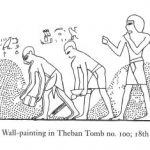
One of the images was found in the tomb of Rekhmire, advisor to the pharaohs Tutmosis III and Amenhotep II. He died in the mid-15th century B.C. In his tomb, many images were found depicting daily activities at that time, and one of them was weighing chufas or tiger nuts.
The Egyptians used chufa in cooking to chew on, cooking in beer and in recipes such as dressings and breads. It was also used as an ingredient in salves and cosmetics, for on the skin, for bowel movements and as an air freshener in combination with myrrh.
Also on the wall of Rekhmire's tomb: a recipe for a sweet snack made from chufa.
The recipe which was on the wall of the tomb translated to today:
Recipe Egyptian rolls anno 1550-1292 BC
Grind whole chufas in a mortar and sieve the flour. Add some honey to the mixture and mix into a dough. Put it in a (metal) baking tin and place it on a fire along with some fat. It is ready when it has become a firm mass, it should not smell burnt but lightly toasted. Let it cool and then cut it into pieces, or form the dough into oblong shapes beforehand.
Our version of this antique recipe:
Recipe Egyptian rolls anno now
Egyptian rolls made from chufa or tiger nuts
The secret of the sandwiches: the texture! They are deliciously crunchy and also delicious without toppings. Perfect for on the go.
Version 1, natural
125 grams of chufa flour 25 g Arrowroot 30 grams of honey 50 ml chufa oil 10 ml water Sea salt
Mix the flour with the salt and oil, add water and honey. Knead into a dough and make 2 balls out of this. Bake for half an hour at 175c.
Version 2, with Middle Eastern spices
Same base as the plain one but add to the flour: 30 grams of chopped apricots, a teaspoon of cinnamon powder, 1/4 cardamon, a little saffron, 1/4 teaspoon aniseed, 1/4 teaspoon allspice and a pinch of vanilla.
Also knead these into 2 balls and bake at 175c for 30 minutes.
From Egypt to Spain
From Egypt, chufas were brought to Spain by the Moors (mainly Moroccan Berbers and Arabs) in the conquest of Spain by the Moors in the 8th century. Where the Moors were only driven out after centuries, the chufa was in Spain to stay. It became the origin for the drink 'orxata (or horchata) de chufa'.
Many places on the internet mention that chufa is rich in resistant starch. Good news you might say and we are only too happy to repeat it. Provided it is substantiated and that proved a bit trickier!
What is resistant starch?
Starch is a food reserve for plants. It consists of 2 parts, amylose and amylopectin. The ratio in chufa starch is1:
11.5% amylose:
is a polysaccharide
Due to its complex structure, it cannot be broken down by the enzyme amylase found in saliva, among others
is also too large in structure to be absorbed by the intestinal wall
is not soluble in cold water but binds water as a thickener
has a firmer structure than amylopectin and is therefore more resistant to digestion. The more amylose contains starch, the more resistant the starch is.
Amylose becomes water-soluble when heated. This means in practice, for example: you boil a potato to eat -> amylose changes its structure when heated and has become soluble rather than insoluble. On cooling, amylose partially regains its insoluble character (it retrogrades) -> a cooked cold potato with resistant starch is the result.
Why be happy with resistant starch
Resistant starch is a dietary fibre, it functions as a fermentable fibre with positive reactions in the intestines:
resistant starch remains more or less intact on its journey through the digestive tract
During its journey, it collects water that encourages regular bowel movements
resistant starch promotes the development of healthy bacteria in the colon
they can accommodate rapid blood sugar fluctuations just like soluble fibre
resistant starch produces fatty acids in the intestines that help with weight loss. They stimulate the production of enzymes that shrink and activate fat cells.
Types of resistant starch
There are 4 types of resistant starch:
Natural resistant starch: RS1: cell wall-enclosed and inaccessible starch in seeds, beans and wholemeal products, among others. RS2: resistant starch granules; these are found in unripe bananas and raw potatoes. Ripening or cooking can make the starch accessible but also less resistant.
Non-natural resistant starch: RS3: the already mentioned retrotreated starch. Occurs in processed products because it is created by heating or cooling, e.g. in cooled, cooked potatoes or pasta or cornflakes. RS4 : resistant by chemical modification (comes from a factory)
Chufa is said to belong to the type 2 resistant starch. When heated, much of the resistant starch disappears. Eating it raw is therefore preferable. As for chufa flour, the amount of starch is the same so I assume also the content of resistant starch. When heated and cooled, RS2 changes to RS3. Studies have shown that the benefits of resistant starch are seen at an intake of 15 to 30 grams per day.
How much resistant starch does chufa contain?
This is where it gets tricky. Almost all websites mention that chufa is one of the best sources of resistant starch, but with no real substantiation. Except in a 2012 study (1) describing the ratio of amylose to amylopectin. Chufa contains 23.7 grams of starch per 100 grams, which contains 2.73 grams of resistant starch according to that study. In comparison, cooled potatoes contain 4.3 grams of resistant starch per 100 grams of product. An amount of 100 grams of cooled potato is also easier to eat than 100 grams of chufa. However, it remains a nightshade and unripe bananas, raw plantain, raw potatoes or potato starch are also not really pleasant foods to consume for various reasons.
Based on this study, nothing wrong, however, our supplier also recently had the level of resistant starch in chufa examined. This showed a completely different figure:
Resistant starch in chufa
It came up with a figure of 0.4%, which is 0.40 grams of resistant starch per 100 grams of chufa. That's not very much...
Then we came upon the following. The chufa is dried after harvest and in that process which takes a few months, some of the starch would be converted into sugars. Perhaps the chufa fresh from the ground contains more starch and therefore more resistant starch... a nice theory until we got clarity on that too. A fresh chufa contains 50% of moisture and 50% of dry matter. Of that dry matter, 50% is starch but so that also ends up being about 25% of starch on 100 grams of chufa. That's less rather than more than is in the dried chufa. It sounded so logical 🙂
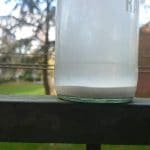
The crazy thing is, when we make horchata (and we have heard this from several customers who have also experienced this), there really is a thick white insoluble layer sticking to the bottom...
Resistant starch in horchata?
After drinking the horchata, the bottle was filled with water. This has all the properties of resistant starch. It is not little and certainly more than 0.4%!
We prefer to write blog articles with a clear outcome but in the case of resistant starch in chufa (or tiger nut), ambiguity is the only clarity...
Anyway, in such cases, logic always wins out. The advice of 15 to 30 grams of resistant starch per day has been established by modern man. Since chufa is a major part of the diet of our distant ancestors mattered, couldn't it be that the chufa is good the way it is? The chufa is so-so a natural source of resistant starch no matter how much and so to eat. Our distant ancestors had fresh chufa but not cooled potatoes, rice, a dehydrator to make raw plantain chips or packets of Honig potato starch... they did, however, roam this earth for about a million years (we only 120,000 years).
So what is really the right amount of resistant starch to consume - perhaps much less than those 15 to 30 grams a day. Or our distant ancestors had less or no damage to the intestinal flora to repair so a little bit was enough...
Almond flour is probably the most widely used alternative to cereal flour and flour for baking in the paleo world. It is a delicious flour and fine for baking. How does chufa flour (tiger nut flour) compare with almond flour?
Nutritional value
First, a nutrient comparison.
What stands out most:
Almond flour is fattier, richer in protein and lower in carbohydrates.
Almond flour has a higher unsaturated fat content than chufa flour. These are less stable when heated than saturated fats. Nevertheless, the fats are unlikely to oxidise (and thus become unhealthy) when heated since the fats are not used as an oil but as a complete food. Also, they are probably not baked at such a high temperature that the fats are no longer stable, as almonds have a smoke point of 216c. Also, the vitamin E protects the fatty acids from oxidation.
The benefits of chufa meal
Chufa flour contains more carbohydrates and less fats than almond flour. It gives chufa flour its sweet taste; almond flour is a bit heavier. The big advantage of this is that you need to use much less sugar in a recipe. Also nice for people who want to eat less fat.
Almonds, as a nut, contain a lot of omega 6, which most people already get more than enough of. Chufas are high in omega 9 and low in omega 6.
the chufa is not a nut but a root vegetable, so it is also suitable in case of nut allergy.
chufas contain short- and medium-chain fatty acids which are quickly absorbed as energy. Almonds contain long-chain fatty acids which are stored as fat.
Furthermore, almonds contain more anti-nutrients than chufas. By using almond flour in a bread, for example, the amount of almonds used is many times greater than if you were to eat almonds loose from your hand. The amount of antinutrients consumed is thus a lot higher.
The benefits of almond flour
Plain Chufa flour can give a somewhat gritty experience. In biscuits, we don't notice it ourselves but it can be present in the somewhat finer baked goods. We just see it as a feature and have no problem with it, other people dislike it. Chufa Flour Extra Fine does not have this, or hardly at all.
Almond flour is rich in calcium and also wins over some other minerals.
almond flour is less dry than chufa flour
Flavour
Almonds taste like... almonds! Chufas have their own flavour, nutty and similar to a chestnut. Chufa flour is a lot sweeter.
Replace almond flour with chufa flour
the sweetness of chufa flour means you need to use less sugar in a recipe. You can easily try it with half the amount.
Due to the lower fat content, it can benefit the recipe if you add some extra fat in the form of chufa oil or coconut oil. Yoghurt also works well.
Adding eggs, gelatine or some extra liquid in the form of, for example, applesauce or puree of pumpkin or parsnip, benefits the recipe as chufa flour can be a bit dry.
Discovery site of the first Paranthropus boisei skull in Tanzania (photo by George Lamson)
In 1959, Mr Charles Boise funded an excavation in Tanzania. In 1959, when archaeologist Mary Leakey was walking through an excavation site with her Dalmatians, she saw something sticking out above the ground. It later turned out to be the first fossil of Paranthropus boisei.
The genus Paranthropus consists of 3 species in total and are also called the robust species. Robust in this case has to do not with the size of the body but with the mouth. Huge jaws, space in the skull for strong jaw muscles, thick tooth enamel and molars that were as much as 4 times larger than today's human molars.
Oxford research
Paranthropus boisei jaw found by Kamoya Kimeu in 1964 (photo by Durova)
Since the excavation, researchers have been working to find out what the P. boisei ate. Its front teeth seemed particularly suited to soft foods, while the molars were for hard foods such as nuts. Bone studies revealed that the P. boisei must have mainly eaten grasses. However, fibrous grasses do not provide enough nutritional value to sustain a humanoid of medium size and relatively large brain.
The solution then came Dr Gabriele Macho from Oxford University visited the original habitat of the P. boisei in Kenya in 2014. There, she saw baboons eating large quantities of tiger nuts which do contain enough starch, vitamins, minerals and fatty acids for the brain.
Raw tiger nuts straight from the ground have an abrasive effect on the teeth which again explained the marks found on fossils of P. boisei. To digest the starch, it was necessary to chew the tiger nuts for a long time to let the saliva do its job.
Even Google does primal humans
She concluded that 80% of the daily energy requirement of 2000 Kcal should be easily found by spending 2.5 to 3 hours a day looking for tiger nuts. The bone study that showed that the P. boisei must have eaten grasses was consistent with this. In that they ate parts of the grass plant, only the tuber which grew between the roots.
Later, P. boisei was nicknamed 'Nutcracker Man' or 'Nutcracker'. Isn't it nice that in retrospect that turned out to be exactly the right description of what the P. boisei ate and how? He cracked nuts, tiger nuts!
Nutcracker Man has roamed our globe for about a million years, modern man about 120,000 years. Hopefully, we too will reach the million years mark thanks to the renewed discovery of tiger nuts. Or chufa as we call them.
ChufaFactory uses cookies to optimise the website.
Functional
Always active
The technical storage or access is strictly necessary for the legitimate purpose of enabling the use of a specific service explicitly requested by the subscriber or user, or for the sole purpose of carrying out the transmission of a communication over an electronic communications network.
Preferences
The technical storage or access is necessary for the legitimate purpose of storing preferences that are not requested by the subscriber or user.
Statistics
The technical storage or access that is used exclusively for statistical purposes.The technical storage or access that is used exclusively for anonymous statistical purposes. Without a subpoena, voluntary compliance on the part of your Internet Service Provider, or additional records from a third party, information stored or retrieved for this purpose alone cannot usually be used to identify you.
Marketing
The technical storage or access is required to create user profiles to send advertising, or to track the user on a website or across several websites for similar marketing purposes.












 NL
NL  EN
EN  FR
FR  DE
DE